Showing posts with label endangered species. Show all posts

Friday, January 10, 2014

Animal Profile: Amur Leopard

To kick off the new year Little Critterz is celebrating the diversity of our wonderful planet by spotlighting a different animal every week! So to start off 2014, we begin with the majestic Amur Leopard of northeastern Asia.


Found in the Primorye region of Russia, the Amur Leopard is the only leopard subspecies that has adapted to a frigid, snowy climate. Like many big cats, the Amur Leopard is an exemplary example of an animal built for hunting. This ferocious feline is known to run at speeds up to 40 miles per hour and can jump ten feet in the air in an effort to capture its prey!


These leopards are characterized as an extremely solitary creature and are known to be very protective of their chosen territory. It is not uncommon for a single Amur Leopard to have a territory of over 100 square miles! Unfortunately though, in the past couple decades, these leopards have lost an estimated 80% of their native territories through harmful activities such as logging and land conservation for farming.


Currently, there are only around 30 Amur Leopards left in the wild. Recently, habitat assessment and anti-poaching measures have been put in place by the Russian Government to help preserve this beautiful animal. While the current situation seems bleak, the recent preservation focus on the Amur Leopard provides new found optimism for the future of this species!


Our goal at Little Critterz is to spread the respect of animals through education of and interaction with animals. We believe this to be done by learning about the wondrous world of animals both online and in person at zoos, national parks and aquariums. We also believe respect, thus protection for animals, stems through admiration of animal, real and treasured symbols, like this Amur Leopard miniature porcelain figurine.

Friday, December 20, 2013

Wildlife Photographer Determined to Photograph Endangered Species and Environments

Photographer Joel Sartore is a 20-year contributor to National Geographic magazine. His assignments have taken him to every continent to document the world's most beautiful and challenging environments. He is on a mission to document endangered species and landscapes, before they disappear, in order to show a world worth saving.

His book RARE: Portraits of America's Endangered Species features portraits of some of the country's most endangered species. "Some of them are likely to go extinct without people ever knowing they existed. Rare shows what we stand to lose if we don’t act now. The good news is that there is still time, and this book highlights what each of us can do to save these unique creatures —and ultimately ourselves."


A bog turtle at Zoo Atlanta.

Woodland Caribou. Less than 40 live in the United States since they rely on old-growth forest habitats.

An ocelot from the San Diego Zoo.

A polar bear from the Tulsa Zoo.

A California condor at the Phoenix Zoo.

A grey wolf at the New York State Zoo in Watertown, NY.


In addition to the work he has done for National Geographic, Joel has contributed to Audubon Magazine, Geo, Time, Life, Newsweek, Sports Illustrated and numerous book projects.

You can purchase his books and fine art prints here.

Friday, October 18, 2013

Who We Support // Orangutan Outreach

More and more rainforests are disappearing due to deforestation and the expansion of palm oil plantations into their rainforest home. As a result, more orangutans are being captured, being smuggled out of Indonesia, or have become pets for plantation workers although it is illegal. They are also starving as a result of deforestation, or dying as a captured prisoner.

They are on the brink of extinction. It is critical that the rescued orangutans are rehabilitated and reintroduced into the wild with the skills needed to survive.

Baby orangutans normally live with their mother for the first six to seven years of their life– until they are strong enough to cope on their own. It takes years to teach the little ones the skills they will need to become independent, wild orangutans.


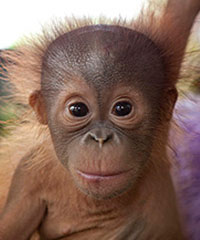
This is Gunung, a baby Orangutan we adopted this year.

Borneo Orangutan Survival (BOS) and International Animal Rescue are in favor of relocating wild orangutans to safer forest areas whenever possible. The BOS rescue center in Nyaru Menteng is the largest rehabilitation program for wild orangutans in the world. Once they arrive, they immediately go through health checks as they are malnourished and have contracted diseases because of contact with humans. After the orangutans have been examined and are deemed healthy they are placed in one of two groups depending on their age and skills. Either they will go to the nursery or to the socialization home.

Nursery School
At the nursery school, they learn to climb. In the wild the babies would be with their mother until they are about 7 years old. They are never alone, like humans they need constant care in first years.  At the nursery they are monitored 24 hours a day. 

Socialization
The larger orangutans are carefully evaluated before deciding where to place them. As a general rule they will be place in so called “socialization” cages where they live together with 10-15 other orangutans and will learn how to live in a group.  Most of the confiscated orangutans have been brought up chained to something in order to restrict their movements and keep them tethered to the ground– lest they mange to escape, which they would naturally do. They have also been living with humans as their only companions. It is therefore imperative for them to get to know other orangutans and create their own social network before being released into the wild. When the orangutans have shown that they can handled themselves in the socialization cages without any problems it is time for the next move.

Halfway House
Once the orangutans can successfully fend for themselves it is time for them to move to a so-called “halfway house”– located a little more than half a mile from the center. Human contacted is purposefully limited. Once the orangutans have learned to build solid nests, find forest food and are choosing to stay in the forest instead of returning to ground homes, it is time for the next stage in the rehabilitation process: the Islands.

Orangutan Island
Close to the rehabilitation center, there are several uninhabited islands in the middle of the river. They are specially protected and still monitored by staff. It is here that Animal Planet’s series Orangutan Island takes place.

The Wild
After a long period of supervision the orangutans are ready to be released into carefully chosen areas in the wild. The release sites must meet a number of criteria including free from human beings and diversity of fruits and plants that can feed the orangutans. The site also has to be in the area of Borneo that the orangutans originate from in order to avoid genetic mix up with other wild populations. 

They are checked up on occasionally by scientific professionals to take blood samples to test for diet and disease. As you can see this is a very long, complex process that requires a lot of time, effort and resources. 

Please visit our support page to see more about what you can do to help save the orangutans.


Orangutan Outreach is a NY based non-profit founded by Richard Zimmerman whose mission is to save the critically endangered orangutans and protect their rainforest home. You can visit their website at redapes.org


Sunday, September 22, 2013

World Rhino Day

Each day 2-3 rhinos are killed for their horns, which in some cultures are seen as having healing powers. 

Between 1970 and 1992, the population of the black rhino species decreased by 96%.
Fewer than 200 Greater one-horned rhinos existed earlier in the 20th century.
There currently are approximately 35-44 Javan rhinos surviving in in one country, Indonesia.
Fewer than 100 Sumatran rhinos are believed to survive on the island of Sumatra, with perhaps as few as ten animals remaining in Sabah, Malaysia. 
Only the populations of the Southern white rhino remain viable.The Northern white rhino is believed to be extinct in its last known habitat in Garamba National Park due to poaching.

Oh stop the horror!

Despite the slaughter, rhino numbers worldwide are actually increasing … thanks to the International Rhino Foundation and its partners in countries like Zimbabwe, Botswana, South Africa, India and Indonesia.


Today, September 22, is World Rhino Day. Where we celebrate all 5 remaining species of rhinos. We've said it before, and we'll say it again days like these are important in the plight to spreading awareness and promoting the aid and rehabilitation of endangered species. See wildlife day blog post here. 

You can help save rhinos from extinction by going to zoos. Supporting your local zoo means supporting research, breeding, rehabilitating and reintroducing these endangered species back into the wild. 

Other ways to help according to the IRF: 

White Rhinos
Support our Stop Poaching Now! campaign. Train and equip rhino rangers in South Africa and Zimbabwe, empower legal professionals to prosecute wildlife crime, and employ specially-trained “Horn Dogs” to track rhino horn poachers and smugglers.
Black Rhinos
Funds are needed to move rhinos threatened by poachers to more secure areas in Zimbabwe’s Lowveld region and for our project to reintroduce the black rhino to Botswana by translocating animals from South Africa.
Greater One-horned Rhinos
Re-establish rhino populations in India’s Manas National Park and Laokhowa Wildlife Sanctuary. Help us increase the number of rhinos in Assam to 3,000 animals by the year 2020.
Sumatran Rhinos
Employ Rhino Protection Units in Indonesia’s Bukit Barisan Selatan and Way Kambas National Parks, home to two-thirds of the world’s Sumatran rhinos, of which only about 100 are believed to remain. Support our breeding efforts at the Sumatran Rhino Sanctuary.
Javan Rhinos
Employ Rhino Protection Units in Indonesia’s Ujung Kulon National Park, the final stronghold for the Javan rhino. Less than 50 remain. If this population disappears, the species will be gone forever.

Friday, September 13, 2013

Four Leopards Found In Remote Valley in Pakistan

The Snow Leopard Trust has found four cats in Pakistan! Now they need to find ways to protect them.

In May and June of this year, the Snow Leopard trust team was able to photograph snow leopards at 19 different sites in Misgar Valley. Misgar Valley is the most northern point of Pakistan, before reaching China. Known for it's remoteness and unpredictable weather of floods, mudslides and snow, the area is a very difficult place to for the team to work.

After extensively evaluating the coat patterns, the team was able to identify at least four cats.

The team took community surveys and found generally negative attitudes towards snow leopards among local herders, mostly due to livestock depletion. Now comes the challenge of working with the community, addressing negative attitudes. The families seem interested in their livestock insurance program, started by Indianapolis Prize 2014 Nominee Charu Mishra.

To the Trust, there are three pillars to conservation:

  • livestock insurance programs
  • livestock‐free wildlife reserves
  • environmental education
These initiatives will restore wild lands, increase wild prey abundance, reduce persecution of threatened predators, catalyze greater use of the habitat by the endangered snow leopard, and raise conservation awareness.

The Snow Leopard Trust, based in Seattle Washington, is a world leader in conservation of the endangered snow leopard.


Little Critterz supports the Snow Leopard Trust, and we are very excited about this recent accomplishment.


sources:
http://www.snowleopard.org/securing-paradise
http://www.snowleopard.org/snow-leopard-researcher-charu-mishra-nominated-for-2014-indianapolis-prize

Wednesday, July 10, 2013

Orangutan Adoption Follow Up

Hi all! We wanted to update you about which adorable orangutan we decided to adopt! You weighed in and we listened, we chose Gunung because of that great smile and his struggle. We are so happy to be able to provide food, care, and support in his journey to rehabilitation and reintroduction into the wild.

Thanks for being apart of this experience with us. We look forward to sponsoring more amazing people, animals and organizations. If you have suggestions, write to us in the comments below.

Check back as we add more organizations to our 'Who We Support' page so you can learn more about these courageous and passionate people helping animals.

We love the world, and know you do too. Let's make a difference together.

Happy Wednesday everyone!

Wednesday, June 12, 2013

Orangutan Adoption

We've decided to adopt an orangutan! Yes, that's right! We are going to be helping Orangutan Outreach and their partners care for rescued orangutans and give them everything they need to be successfully reintroduced into the wild.

So help us choose which orangutan!

GUNUNG

The International Animal Rescue team got an emergency call from the local forestry department informing them that a man had found a tiny baby orangutan alone in a tree in an area called Tanjung Gunung. It’s hard to say what really happened, but one thing is for sure: It is highly unlikely that 2-3 month-old baby orangutan would be alone in the forest without any sign of his mother. The little fellow was given the name “Gunung “ which means “Mountain” in Bahasa Indonesian.


RICKINA

Rickina was rescued in the capital city of Pontianak, West Kalimantan, from a man who claimed that he had encountered a mother orangutan with the baby in the forest, and that the mother was so startled that she abandoned the baby and ran away. The man picked up the baby and in doing so apparently caused a gaping wound on her head with his machete…. A mother orangutan will never leave her infant behind and will fight to the death to protect her baby from aggressors. So what really happened?

Cast your vote in the comment section. Or visit our Facebook page and comment there!

Sunday, April 28, 2013

10 Most Endangered Animals


10. The little dodo bird, an island ground pigeon. Native to Samoa, and only twelve inches in length, it's relative is the famous large dodo bird from Mauritius which became extinct 400 years ago. They are disappearing at an alarming rate due to habitat loss and illegal hunting. Survey suggests less than 200 dodo birds exist. Worse still, there are no dodo birds in captivity.


9. The Chinese giant salamander, native to central, southwestern and southern China, is the world's largest amphibian (reaching up to 6 feet!). Although it can lay up to 500 eggs at a time, then guarded by the males, they have almost completely disappeared due to over-exploitation as a food source.


8. The Siberian (Amur) Tiger, the largest big cat in the world, living in negative 50 degree climates of Russia. Due to hunting, the Siberian saw a decline to just 40 tigers in the 1930s, now population estimates are around 500. Read our post about the tiger here.


7. Leatherback Sea Turtle, despite having the largest regions of habitats (spreading from tropics to subpolar regions), population has plummeted from over 100,000 female Leatherback Sea Turtles to just 30,000 14 years later, and the number continues to fall at alarming rates. The biggest threats to these turtles is ingesting plastic bags, which they confuse as food like jellyfish, humans stealing their eggs, illegal hunting, beach development, and beach erosions due to climate change.


6. Western Lowland Gorilla and Cross River Gorilla, both native to West Africa. Although the Western Lowland Gorilla is much more numerous than the Cross River, they have seen a 60% population decline in the last 25 years. Threats include habitat loss, illegal commercial hunting by poachers and the ebola virus.


5. Northern Right Whale was named for it being the right whale to kill as it was full of valuable whale oil but it also floats when it's dead, making it easy to handle and process. As a result, it was driven to near extinction. Entanglements in commercial fishing, and climate change affecting crustaceans on which the whales feed threatens the existence of the Northern Right Whale.


4. Northern Sportive Lemur, or any of the other 100 species of lemurs. All species live on the island of Madagascar and are declining drastically in population due to illegal hunting and habitat deforestation from logging. Researchers have recently reportered there may only be 20 wild Northern Sportive Lemurs. Less than 100 Greater Bamboo Lemurs exist in the wild.


3. Javan Rhinoceros is the most threatened of the 5 rhino species. Between 40-60 remain in the Ujung Kulon National Park and the last of a small group in Vietnam was killed by poachers. The Javan Rhinoceros has been hunted to near extinction for it's horns.


2. Amur Leopard which lives in snowy Russia, a rare breed adapted to this climate. Similar to the African leopard, the Amur can run at speeds up to 37 miles per hour (60 km/hour). Only 30 Amur Leopards remain in the wild. The threats, habitat loss due to logging, roads and civilizations, illegal hunting and climate change.


1. Ivory-Billed Woodpecker which lives, or lived in southeastern US and Cuba. It was listed as extinct in 2004, but few reports of sightings have been made in Florida and Arkansas. Extinction has been caused by habitat deforestation (logging) and human exploitation for it's feathers.


Friday, March 29, 2013

Vulnerable to Extinction: Tigers

The colors, those eyes, the prowl. The majestic tiger mesmerizes wildlife park goers like few else. Perhaps because the majority of people have seen a tiger in front of them, or knowing of their strength in hunting, there is a misconception that they rule the jungle. But they are threatened, in fact, as little as 3,200 wild tigers are left.

Every species of tiger is endangered. Until the 20th century there were nine tiger species. Three are extinct - the Caspian, Balinise and Javan tigers. In one century, 97% of the tiger population was hunted and killed. Today we see their habitat being destroyed for agriculture, timber and construction of roads and cities. Poaching these animals for illegal trade of parts is at an all time high.

Help these tigers before they become just a memory of what once was.


Wednesday, March 20, 2013

Snow Day for Xiao Liwu at San Diego Zoo

Today may be the first day of Spring, but yesterday March 19, Panda cub Xiao Liwu and mom Bai Yun ran around, played and enjoyed the snow provided by the San Diego Zoo, through the help of generous donors. It was Xiao Liwu's first time seeing the snow, and after a little hesitation he stepped onto the cold surface and began to enjoy play time with his mother. As is snows in China, the Pandas are a bit spoiled with the nice Southern California weather. It is a real treat for the Pandas to play in an inherently familiar setting.

Xiao Liwu was born in July of 2012, the 6th Panda cub to be born at the San Diego Zoo, thanks to a 12-year research loan from China.

You can see Xiao Liwu, Ban Yun and the other Pandas live through San Diego Zoo Panda Cam.  Become a member of San Diego Zoo Wildlife Conservancy here.